Popularisation of Vera Rubin's theory and further study
How did Vera Rubin revolutionise cosmology ? Through her study of galaxy rotation, discover dark matter: a central enigma of the modern universe, still at the heart of major research in astrophysics.


Classical laws and galactic rotation*
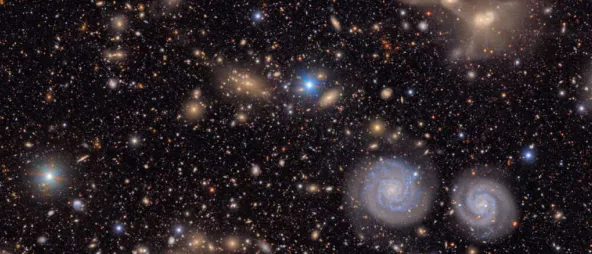
In the 1970s, Vera Rubin became interested in how stars revolve around the centre of galaxies, particularly in spiral galaxies such as Andromeda. According to known laws (such as Newton's), stars furthest from the centre should rotate more slowly than those near the heart of the galaxy, much like the planets in the Solar System.
In the 1970s, Vera Rubin became interested in how stars revolve around the centre of galaxies, particularly in spiral galaxies such as Andromeda. According to known laws (such as Newton's), stars furthest from the centre should rotate more slowly than those near the heart of the galaxy, much like the planets in the Solar System.
The existence of invisible matter
To explain this unexpected phenomenon, Rubin proposes the existence of a massive but invisible mass: dark matter. This matter cannot be seen directly, as it emits neither light nor any form of detectable radiation, but exerts a gravitational influence on the stars and gas in galaxies.
In other words, there must be a huge ‘missing piece’ of mass in the Universe, which acts as a gravitational glue and prevents galaxies from breaking apart under the effect of their own rotation. According to estimates, this dark matter accounts for more than 80% of the total mass of the visible Universe !
Current challenges in dark matter research
Today, dark matter is a central area of research in astrophysics. It has not yet been detected directly, its effects are observed, but its exact nature remains unknown. Several avenues are being explored, imagining that it could be new massive particles that interact only very weakly with light or ordinary matter.
In summary, thanks to Vera Rubin, astronomers have become aware that a large part of the Universe escapes us. Her work paved the way for modern cosmology: it changed the way we see the cosmos and launched one of the great scientific quests of our time.