Vera
RUBIN
A pioneering astrophysicist, Vera Rubin revolutionised our understanding of the universe by revealing the existence of dark matter. Discover the journey of a committed woman, a tireless mentor and a symbol of the fight against the invisibility of women in science.


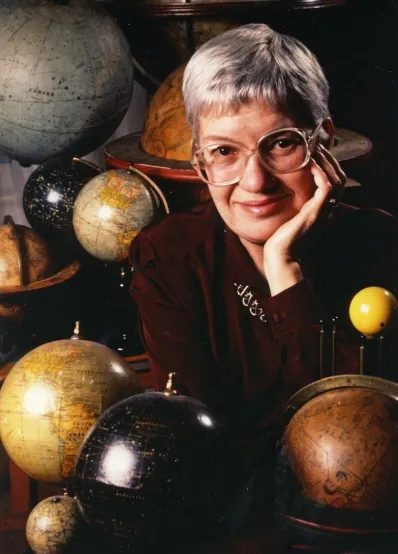
Vera Rubin, pioneer of astronomy and explorer of the mysteries of the Universe
Born on 23 July 1928 in Philadelphia, Vera Cooper Rubin developed a passion for the stars at the age of 12, encouraged by her father, who helped her build her first telescope. Despite the pressures and doubts she encountered in a male-dominated scientific world, she pursued her higher education at Vassar College, the only university that accepted women in astronomy at the time.
Her academic career, crowned by a thesis on the distribution of galaxies under the supervision of physicist George Gamow, revealed her keen sense of observation and ambition for fundamental research at an early stage. With her determination, Vera Rubin overcame many obstacles: she was often the only woman in her collaborations and sometimes had to adjust her research schedule to care for her four children.
Pioneering studies in the face of adversity
From the 1960s onwards, Vera Rubin conducted major observations at the Kitt Peak telescope, then at the Mount Palomar Observatory, which was then off-limits to most women. Her work on the rotational speed of stars at the edge of galaxies revealed the existence of an invisible mass, dark matter, which explains why galaxies do not rotate as predicted by classical laws.
Her research was revolutionary! Dark matter, now a central topic in cosmology, makes up the majority of the mass of the universe and opened up a new field of scientific research.
The impact of the Matilda effect on her career
Despite the evidence and global impact of her results, Vera Rubin did not receive the Nobel Prize nor the honors accorded to several male colleagues. She thus embodies the "Matilda effect"*, which describes the erasure of women in scientific memory.
Beyond her discoveries, she stands out for her personality and generosity towards future generations. Humble, she cared more about the progress of science than personal recognition, stating that the greatest compliment is that her data continue to serve researchers.
Vera Rubin also stood out as a mentor, particularly to young women wishing to pursue astronomy. She wrote numerous letters of recommendation and actively supported the careers of her female students. One of them, Sandra Moore Faber, became a major figure and described Rubin as "a light that guided a generation of women astronomers."
Her commitment to openness and diversity is evident in her public speeches, such as her speech at Berkeley where she reminds that "Science is competitive, demanding, but also imaginative, fertile, exhilarating," encouraging everyone to persevere with curiosity.
A legacy engraved in science
Recognition finally came, notably with
the
National
Medal of Science
awarded by Bill Clinton in 1993 and
the Gold Medal of the Royal Astronomical Society in 1996.
As proof of her lasting influence, one of the world's largest
observatories today bears her name: the Vera
Rubin Observatory, inaugurated in Chile in 2020, which will revolutionise
the observation of the cosmos for decades to come.
Her name and legacy are thus engraved in the collective memory
of the scientific community as a symbol
of emancipation, commitment and excellence for all
future generations.
Vera Rubin passed away in 2016, leaving behind a
more open scientific community, a better understood universe
and a permanent invitation to continue the quest
for the invisible. Her legacy is a source of inspiration for
anyone passionate about science, equity and curiosity.

Matilda timeline
Unfortunately, Vera Rubin is not the only woman to have been overlooked in the history of science...
If you would like to find out more, we invite you to take a look at a short timeline featuring important women who have been overlooked in the history of science: